
Loading…

Loading…
 MiZa Observation Deck
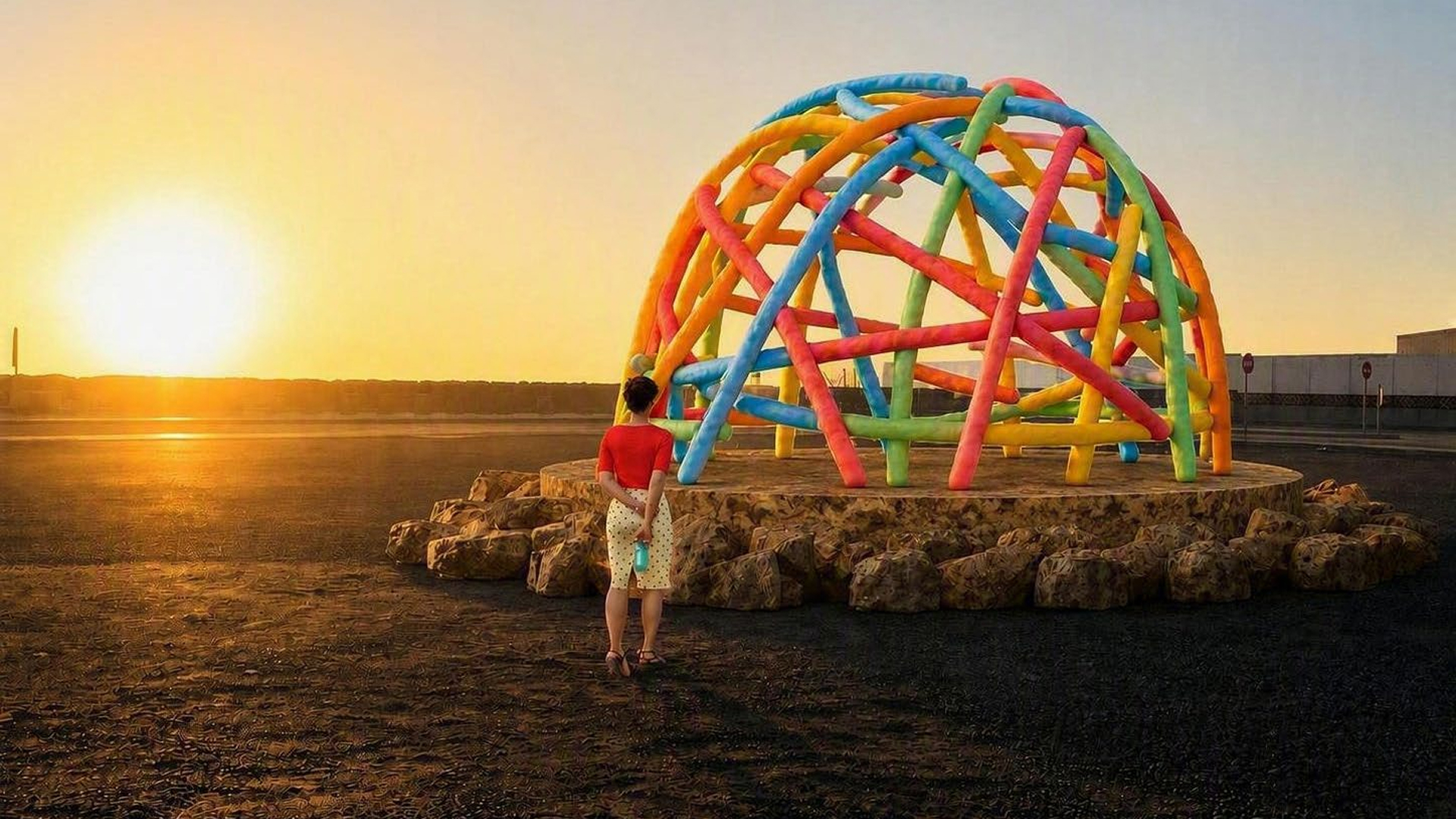
Khalid Al Banna’s sculptural practice explores geometry, space, and the relationship between solid and void through a refined, minimalist visual language. Gargour (2026) reimagines the traditional Emirati fishing trap, a familiar symbol of the region’s maritime heritage, through an architectural language of space, containment, and invisible boundaries. Transforming the trap’s inner void into its central conceptual force, the work reveals space as an active presence that shapes form and perception. Rendered in soft primary and secondary colours—red, orange, yellow, green, and blue—the sculpture distances the gargour from its utilitarian origins, translating a familiar maritime object into an abstract contemporary form. Gargour reflects on home and heritage as living forms, continually reimagined through memory, place, and lived experience.
Sharjah, UAE
Khalid Al Banna is an Emirati artist whose sculptural practice explores geometry, spatial relationships, and the interaction between form and void. Drawing on his background in architectural engineering, he approaches sculpture as an architectural system, using structure, proportion, and material to examine how forms occupy space. Open space becomes an active element, shaping perception alongside the material itself, while light and shadow reveal new spatial relationships. Moving between abstraction and references to familiar forms, his sculptures consider how objects can be reimagined through scale, structure, and their relationship to place. His work has been presented in exhibitions and public art initiatives across the UAE, including Union of Artists, commissioned by Dubai Culture (2023), Dhai Dubai at Expo City Dubai (2025), a public art commission for Art Dubai (2026), and the Tanweer Festival, Mleiha, Sharjah (2026).
Loading map…
MiZa Observation Deck
Akram Zaatari

MiZa Observation Deck
Nari Ward
MiZa Observation Deck
Shama Al Hamed
